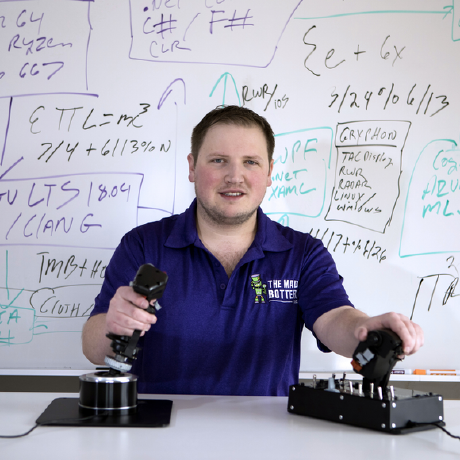
I’ve spent a lot of time recently reflecting on 2026 as the Year of the Linux Desktop. While I stand by the idea that “opinionated software” like COSMIC is the warp drive we’ve been waiting for, looking back from the bridge of The Mad Botter reveals a different sensor reading.
The “Year of Linux” isn’t just a win for the desktop; it’s the final stage of a silent coup led by the embedded sector. At The Mad Botter, our mission is to act as an elite modernization agency for the Aviation MRO sector. We spend our days untangling 1990s legacy data and hooking it up to real-time shop-floor telemetry.
The reality is clear: the “Desktop” is no longer a standalone ship—it’s the command center of a much larger, Linux-powered fleet.
The Trojan Horse in the Hangar
While the tech press is busy arguing about whether Windows 11 “Recall” is a privacy nightmare (it is), the industrial world has quietly moved to the Penguin. When we deploy our Vorpal interface to modernize an ERP, we aren’t just putting a shiny coat of paint on a legacy system; we are deploying a modern, IoT-connected dashboard on top of cleaned, high-integrity data.
In 2026, your “Desktop” is a node. If your tractor, your CNC machine, and your aircraft’s diagnostic sensors are all running Linux, trying to manage that fleet from a proprietary OS feels like trying to hail a Star Destroyer with a rotary phone. It’s inefficient, and frankly, it’s a security risk to the Enterprise Trust we build for our clients.
Open Source as the Prime Directive
We’ve built our entire agency on the belief that “black box” software is a relic of the Old Republic. We don’t just build software; we build the architecture the rest of the industry relies on.
- The Backend Engine (Alice): We safely migrate and untangle decades of FoxPro and Access compliance data without risking daily operations.
- The Frontend Interface (Vorpal): This is the modern, IoT-connected face of the operation, turning reactive maintenance into predictive intelligence.
- Technical Validation: Our engineering is so robust that we open-source our foundational data-lake (
PG-Lake-Make) and IoT architecture (dredger-iot) for the developer community.
“When you hire The Mad Botter, you are hiring the engineers who write the playbook.”
The Executive Shift: From Resistance to Sovereignty
The real reason 2026 is the tipping point isn’t just because Linux got better—it’s because C-Suite and IT Directors are tired of being held hostage by legacy vendors. They want the modernization we provide because it gives them sovereignty over their own data.
As I’ve discussed on the Coder.show podcast—where the industry goes to understand the future of software architecture—the future isn’t about which OS has the best UI. It’s about Edge-to-Cloud parity. If you are running Linux at the edge (IoT) and Linux in the cloud (Alice), putting a proprietary middleman in the driver’s seat of your workstation is a tactical error.
Final Thoughts from the Hangar
The “Year of the Linux Desktop” isn’t a conquest; it’s an invitation to join the rest of the galaxy. The embedded world and the IoT revolution have already built the infrastructure. 2026 is simply the year we stop fighting the inevitable and realize that the most powerful tool in the hangar has a penguin on the side.
Resistance to open standards is futile. And in Aviation MRO, downtime is the one thing no captain can afford.
End Transmission.
Want to see the architecture behind the insurgency? Explore our Open Source foundations on GitHub or listen to the latest tactical briefings on Coder.show.