Table of Contents
- Why Hiring Software Engineers for Manufacturing Is Different
- What to Look for in Manufacturing Software Development Services
- The Real Cost of Hiring Domestic Software Developers
- How to Vet Software Engineers for Industrial Systems
- Manufacturing Systems Integration Best Practices
- Onboarding and Retaining Engineers in Industrial Settings
- Frequently Asked Questions
Last Updated: September 12, 2026
Why Hiring Software Engineers for Manufacturing Is Different
Hiring us based software engineers for manufacturing looks nothing like hiring for a SaaS product team. The work sits where operational technology meets information technology, where a scheduling bug can stop a production line and a bad migration can corrupt quality records traced to an aerospace customer. This guide from The Mad Botter shows owners and operations leaders how to scope, vet, and onboard engineers who understand the shop floor, not just the cloud.
The core tension is simple. Generalist engineers optimize for user experience and scale; manufacturing engineers optimize for uptime, traceability, and the physical consequences of a failed write. A candidate who has never touched a PLC or an MES will spend months learning why the plant will not let them restart a server at 2 p.m. on a Tuesday.
Three things separate a good manufacturing hire from an expensive mistake:
- Domain fluency: familiarity with industrial software, ERP and MES boundaries, and shop-floor constraints.
- Integration instinct: the ability to connect systems rather than replace them.
- Operational empathy: understanding that a 10-minute outage has a real cost measured in idle machines and late shipments.
What to Look for in Manufacturing Software Development Services
Manufacturing software development services succeed or fail on two axes: technical depth and industry context. A provider strong in one but weak in the other produces code that works in a demo and breaks in production.
Technical Skills That Actually Matter on the Shop Floor
Start with the languages that show up in real plants. Python and C# dominate integration and application work, while C and C++ still appear in embedded systems and firmware (nist.gov). SQL fluency is non-negotiable because so much manufacturing data lives in relational databases behind an ERP.
Beyond languages, look for hands-on exposure to:
- PLC programming and how control logic interacts with higher-level systems.
- SCADA and IIoT data flows, including how tags and historians are structured.
- Manufacturing execution systems and where they sit relative to ERP.
- System integration patterns such as REST APIs, message queues, and file-based handoffs that legacy equipment still relies on.
A common mistake is hiring a strong web developer and assuming they can pick up industrial protocols on the job. Most underestimate how much of the work is reading old documentation and reverse-engineering a system nobody fully understands.
Industry Experience: Manufacturing and Logistics Integration
Ask candidates to describe a time they connected logistics software to a production system, or reconciled inventory between an ERP and a warehouse system. Someone who has mapped a bill of materials across two systems, or debugged a shipping label that printed the wrong revision number, will understand your operation faster than someone who has only shipped consumer apps.
The Real Cost of Hiring Domestic Software Developers
The cost of hiring us based software engineers for manufacturing is higher on paper than offshore alternatives, and that gap is real. What the headline rate hides is the total cost of coordination, rework, and downtime when a team lacks context. For a manufacturer, the loaded cost is salary plus benefits, equipment, tooling licenses, onboarding time, and the cost of mistakes made while learning your plant.
Full-Time vs. Contract vs. Managed Partner
Full-time employment makes sense for continuous, evolving needs: an internal application requiring ongoing maintenance, or a multi-year integration roadmap. Contract engineering fits defined projects with a clear endpoint, such as migrating a legacy system. A managed partner fits the middle ground, recurring work without a permanent headcount commitment.
| Model | Best For | Main Trade-Off | Typical Engagement Shape |
|---|---|---|---|
| Full-time employment | Ongoing ownership of internal systems | Higher fixed cost, slower to scale, single point of failure risk | Indefinite, salaried |
| Contract engineering | Defined projects with clear scope | Knowledge leaves when the contract ends | 3-12 months, project-based |
| Managed partner | Continuous support without hiring | Less direct control over priorities | Retainer or statement of work |
For many small and midsize manufacturers, a managed partner handling both delivery and ongoing support avoids hiring one person who becomes a single point of failure.
What Drives Compensation Up or Down
Rather than anchor to a single number, benchmark against your local market and weigh total compensation. Four factors move the number most:
- Industrial domain depth. An engineer who knows MES, SCADA, and ERP boundaries commands more than a generalist web developer, because ramp time is shorter and the risk of a production-impacting mistake is lower.
- Compliance exposure. Roles touching ITAR-controlled data or CMMC-scoped systems require documented handling practices and often a higher rate (dodcio.defense.gov).
- On-call and uptime expectations. If the role owns a system running during production hours, compensation must reflect that a 2 p.m. Tuesday restart is not an option.
- Geography and remote policy. A fully remote role widens the candidate pool and can flatten the rate; an on-site role near a manufacturing hub narrows it and pushes the rate up.
A senior engineer who prevents one production outage often costs less than the downtime they avoid. Compare domestic hires against cheaper alternatives on total cost of ownership, not rate against rate.
Hiring a single engineer to own a critical system without documentation or backup creates the same risk you already have with the one employee who knows how the process works. If that person leaves, you are back to square one, and you paid a premium for the privilege.
The Hidden Cost of a Bad Hire
A bad hire in a manufacturing software role costs more than in most software roles because the blast radius is physical. The costs stack:
- Ramp time that never converts. Three to six months of salary before you know whether they can read a legacy system (peer-reviewed research).
- Rework. Code that works in a demo but breaks against real ERP data must be rewritten, often by someone else.
- Production disruption. A bad integration can stall scheduling, corrupt traceability records, or force manual workarounds that erase the intended efficiency.
- Replacement cost. Recruiting, onboarding, and lost momentum when the hire does not work out.
The cheapest way to control this cost is to front-load vetting, which is the next section.
How to Vet Software Engineers for Industrial Systems
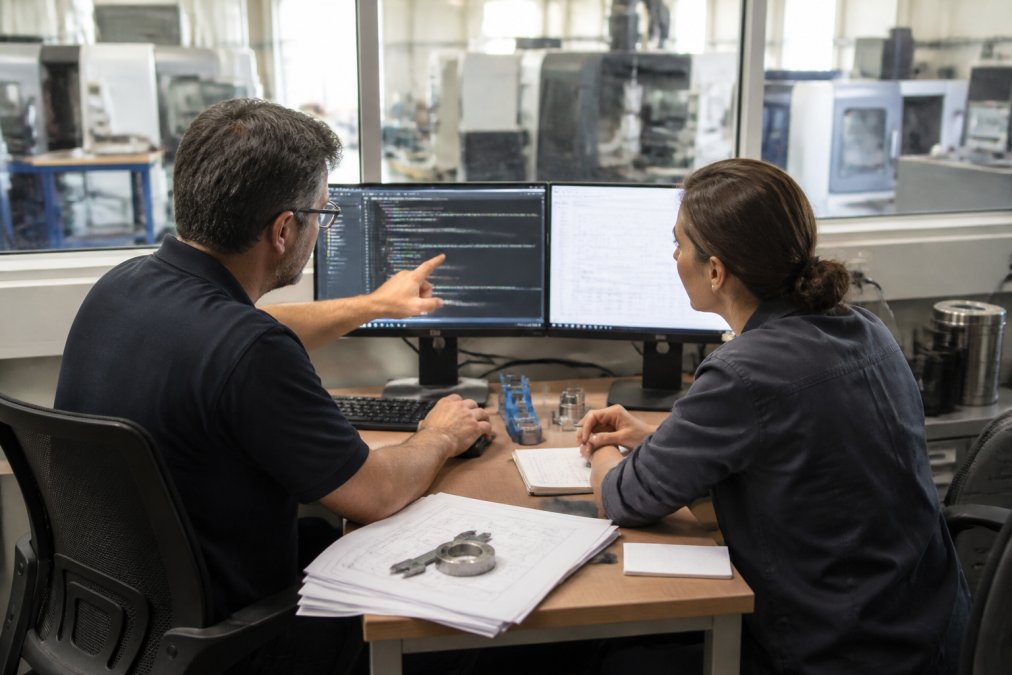
Vetting for industrial systems requires a technical assessment beyond algorithms. You want evidence they can work inside constraints they did not design. The employer-side gap is a repeatable process for separating engineers who have actually touched a plant from those who have only read about one.
A Four-Stage Vetting Process
Run every candidate through the same four stages so you compare them against each other, not your gut.
- Screen for domain vocabulary. In a 30-minute call, ask them to explain the difference between an ERP and an MES, and where a historian sits relative to both. Candidates with real exposure answer in terms of systems of record and data flow; those without recite definitions.
- Present a realistic integration scenario. Strip a real problem of sensitive details and ask for a written approach. A strong answer covers data ownership, update frequency, error handling, and what happens when the connection drops. A weak answer jumps straight to a technology choice.
- Review how they handle legacy constraints. Ask what they would do if the ERP vendor refuses to expose an API. The right answer involves file-based handoffs, scheduled exports, or middleware, not a greenfield rewrite.
- Check references for integration work. Ask for a project where they collaborated with an existing ERP vendor or managed service provider. Anyone who has done this will have stories about vendor tickets and change windows.
Interview Questions That Reveal Real Experience
Use open-ended questions that force candidates to describe a mechanism, not a buzzword.
- “Walk me through how you would connect an ERP to a quality system so inspection results attach to the correct job. What is the system of record for each field?”
- “Tell me about a time an integration failed in production. How did you detect it, and how did you recover?”
- “How do you decide whether to extend a legacy system or replace it? What signals push you toward each?”
- “Describe a time you had to say no to a shortcut for compliance or safety reasons. What happened next?”
- “How would you structure a rollback plan for a change that touches scheduling?”
Score each answer on domain fluency, integration instinct, and operational empathy. A candidate strong on two but weak on the third is a coaching project, not a hire.
Compliance and Security Requirements
If you operate in aerospace or defense-adjacent work, compliance is not optional. Ask how a candidate has handled ITAR-controlled data and whether they know CMMC requirements. The right answer includes access controls, data segregation, and documented handling procedures. Vague assurances are a red flag.
Concrete signals to listen for:
- Named access-control models (role-based, least privilege) rather than “we locked it down.”
- Awareness that controlled technical data cannot be stored or processed in unauthorized environments.
- Familiarity with audit trails and how they map to traceability requirements.
- Willingness to slow a project down when the compliance path is unclear.
Ask candidates to walk you through a time they said no to a shortcut for compliance reasons. The answer tells you more about their judgment than any certification list.
Red Flags and Green Flags
Red flags: cannot name a system they integrated with; treats the shop floor as an inconvenience; proposes replacing the ERP in week one; has no story about a production failure; answers compliance questions with reassurance instead of practice.
Green flags: asks about data ownership before choosing a technology; has a rollback plan ready; references a specific vendor ticket or change window; describes documenting a system nobody else understood; treats uptime as a design constraint, not an afterthought.
Manufacturing Systems Integration Best Practices
Manufacturing systems integration best practices start with one rule: connect existing systems before replacing them. Most plants already have an ERP that works for finance and a production process living in spreadsheets because the ERP does not cover how the business actually runs.
Connecting ERP, MES, and Legacy Systems
Map the data flow before writing code. Identify the systems of record for quoting, scheduling, inventory, production, quality, and shipping, then define the integration points and direction of truth for each field.
- Establish a single source of truth for each data element.
- Document every handoff, including manual steps that will be automated.
- Build error handling and alerting into every connection.
- Keep legacy interfaces working until the replacement is proven.
The goal is not a big-bang replacement but eliminating double entry, spreadsheet tracking, and manual paperwork. A partner that collaborates with your ERP vendor and MSP, rather than replacing them, keeps the project scoped and the risk contained.
Onboarding and Retaining Engineers in Industrial Settings
Onboarding in industrial settings fails when engineers are kept away from the floor. The fastest way to lose a good hire is handing them a laptop and a ticket queue with no context for why the work matters.
Bring new engineers onto the shop floor in the first week. Let them watch a job move from quote to shipment, and show them where the spreadsheet breaks and the status calls start. That context turns abstract tickets into operational problems they can solve.
Retention follows the same logic. Engineers stay when their work reduces manual effort and improves traceability. Give them ownership of a defined outcome, not just tasks, paired with clear scope and acceptance criteria to avoid open-ended consulting that burns out both sides.
The manufacturers who keep good engineers treat them as operators of critical systems, not as outside help. Ownership and visible impact are what keep them.
Manufacturing teams that get this right stop firefighting and start building. The hard part is finding engineers who understand both the code and the plant, and that is exactly the gap The Mad Botter was built to close. We are a founder-led, US-based firm with senior engineers only, no offshore subcontracting, and a focus on manufacturing ERP integration, workflow automation, and legacy software modernization. We start with one clearly defined operational problem, agree on scope and acceptance criteria, and deliver a working solution using your existing systems. If your operation depends on spreadsheets and workarounds, tell us what’s stuck and we will help you fix it.
Frequently Asked Questions
What is the average salary for a manufacturing software engineer in the U.S.?
According to the Bureau of Labor Statistics, software developers earned a median annual wage of $132,270 as of May 2024, with the highest 10% earning more than $211,450. Engineers with PLC programming, SCADA, or MES integration experience often command higher compensation because those skills are scarce. Manufacturing-specific roles may also include bonuses tied to production uptime or system reliability. For current market rates in your region, check BLS data for your state or consult industry salary surveys.
Should small manufacturers hire full-time or contract software engineers?
It depends on the scope and duration of your needs. Full-time hires make sense when you have continuous integration work, ongoing system maintenance, and a long-term digital transformation roadmap. Contract or consulting arrangements work better for defined projects like ERP integration, legacy modernization, or a specific automation build. Many manufacturers start with a contract engagement to prove the working relationship, then convert to full-time if the workload justifies it. The key is matching the engagement model to the actual scope.
How do you vet software engineers for industrial machinery and CNC integration?
Start with a technical assessment that mirrors your actual environment. Ask candidates to walk through a real integration scenario: connecting a CNC machine to an MES, pulling production data into an ERP, or building a quality tracking workflow. Look for experience with PLC programming, SCADA systems, IIoT protocols, and industrial software. Check whether they understand operational technology constraints like network segmentation and machine uptime requirements. Also verify their software development lifecycle practices, including testing, version control, and documentation. References from similar manufacturing environments are the strongest signal.
What are the benefits of hiring domestic software engineers for manufacturing?
Domestic engineers work in your time zone, which matters when production issues need same-day resolution. They understand U.S. regulatory requirements like ITAR, CMMC, and FDA quality standards because those frameworks apply to their work directly. Communication is easier when there is no language or cultural gap during critical system changes. On-site visits to your shop floor become practical rather than a logistical burden. For manufacturers in aerospace, defense, or regulated industries, domestic hiring also simplifies compliance audits and supply chain security reviews.