Table of Contents
- What Bespoke ERP Means for Discrete Manufacturing
- Production Visibility and Real-Time Data
- Inventory Accuracy and Work-in-Progress Tracking
- Custom Manufacturing Software Development for Your Workflow
- Integrating Legacy Systems with Modern ERP
- Bespoke vs Off-the-Shelf ERP Cost Comparison
- Reducing Implementation Risk and Change Management
- Frequently Asked Questions
Last Updated: September 30, 2026
What Bespoke ERP Means for Discrete Manufacturing
A bespoke ERP discrete manufacturing system is a customized enterprise resource planning solution built or heavily modified to match how your specific business actually operates, not how a generic software vendor thinks you should operate. Unlike off-the-shelf solutions that force your workflows into predefined boxes, bespoke systems connect your quoting, scheduling, inventory, production, quality, and shipping processes exactly as they happen on your shop floor.
For precision manufacturers, CNC shops, metal fabricators, and custom equipment builders, this distinction matters. Most businesses run multiple disconnected systems and spreadsheets because their ERP doesn’t reflect reality. Operators re-enter data. Planners chase job status manually. Quality records live in separate silos. A bespoke approach eliminates those gaps by building the system around your actual processes.
The Mad Botter helps manufacturers fix these disconnects. Bespoke ERP solves this by treating your existing systems as assets to connect, not obstacles to replace.
The real value of bespoke ERP isn’t the software itself, it’s operational visibility. When your quoting, scheduling, inventory, and production data flow without manual handoffs, you see bottlenecks immediately and make faster decisions.
Production Visibility and Real-Time Data
Real-time visibility into production status is where bespoke ERP delivers its most immediate impact. In a discrete manufacturing environment, you need to know which jobs are running, which are queued, which are behind schedule, and which are about to hit a quality hold, not at end-of-day reporting, but right now.
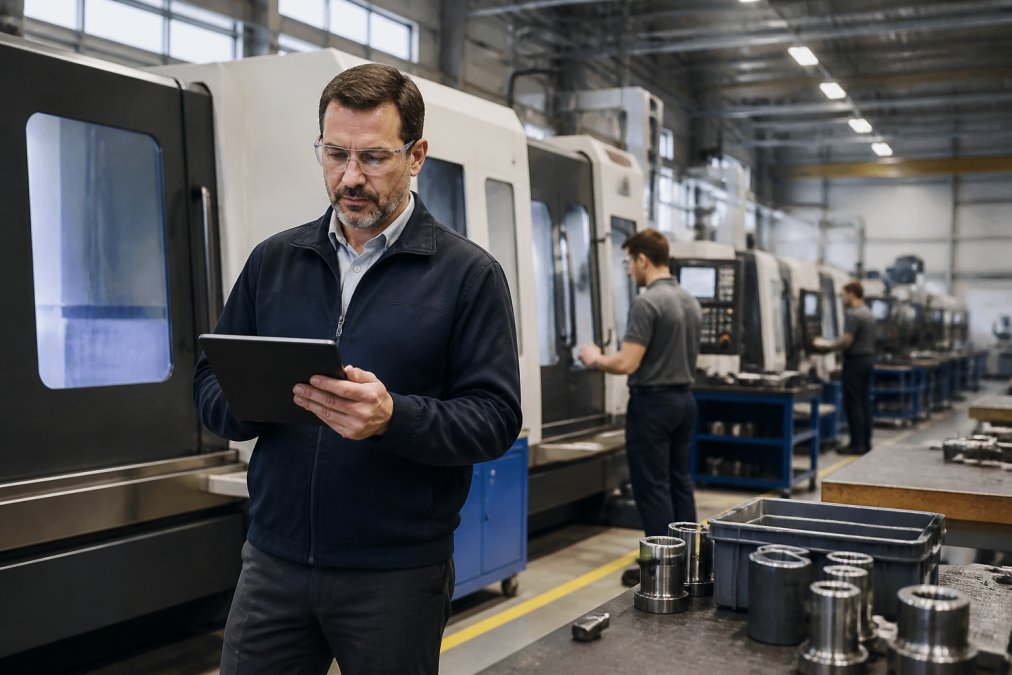
Off-the-shelf systems often disconnect from the shop floor. Operators log time in one system, quality data lives in another, and your ERP sees a consolidated view hours later. By then, a bottleneck has already cascaded. Bespoke systems integrate directly with your production equipment, work instructions, and quality checkpoints. Data flows in real time, not through batch uploads or manual entry.
This visibility enables faster decision-making. When a job hits a quality hold, the system flags it immediately. When a machine goes down, scheduling can reroute work before the planner even notices. When demand forecasting shows a surge, you see the impact on material lead times before you commit to a delivery date.
The data also becomes actionable for continuous improvement. You can see which operations consume the most time, where rework happens most often, which customers’ specs drive the most scrap, and which scheduling patterns minimize changeover. That’s not just reporting, that’s operational intelligence built into your daily workflow.
Inventory Accuracy and Work-in-Progress Tracking
Inventory accuracy in discrete manufacturing is rarely about counting widgets in a warehouse. It’s about tracking work-in-progress (WIP) through multiple stages: raw materials waiting to be machined, parts in process at different operations, assemblies waiting for subcomponents, and finished goods ready to ship.
Most shops manage WIP through spreadsheets or manual counts. An operator finishes a batch and updates a status sheet. A planner recalculates material needs based on outdated inventory. A quality hold on one part cascades because nobody sees the dependency until the next day. Bespoke ERP tracks WIP at the operation level, not just the part level.
When a job moves through your shop, the system knows exactly where it is, what stage it’s in, and what’s blocking it. If a part is waiting for an outside process, heat treating, plating, anodizing, the system tracks that external dependency and flags when it should arrive back. Material reservations update automatically as jobs progress, so your available inventory is always accurate.
This accuracy directly reduces lead times. Instead of building extra safety stock because you can’t trust your inventory data, you work with real numbers. Planners can see which materials are bottlenecks and adjust sourcing earlier. Operators know exactly which parts to pull for the next job, eliminating the time spent searching for materials or discovering parts are already allocated.
Accurate WIP tracking means you stop discovering surprises mid-production. Jobs flow predictably, material holds decrease, and you ship on time more consistently.
Custom Manufacturing Software Development for Your Workflow
Not every manufacturing process fits a standard template, which is why bespoke ERP discrete manufacturing solutions are essential. A CNC job shop has a completely different workflow than a metal fabricator, which differs from an electromechanical assembly operation. Off-the-shelf ERP tries to be everything to everyone, which means it’s truly optimized for nobody.
Custom manufacturing software development starts with your actual workflow. How do you quote? Do you bid on drawings, specifications, or both? How do you handle change orders mid-production? How do you manage outside processing, and do you track it by vendor, by operation type, or both? How do your quality checks integrate with scheduling? Do you have a first-article inspection process that gates production, or do you run in parallel?
These details matter because they determine whether your ERP supports your business or fights it. A bespoke system is built to answer your questions, not force you to rephrase them for the software. If your sales team needs to see which jobs are at risk of missing delivery, that report exists. If your operations team needs to see which machines are overbooked next week, that visibility is built in. If your quality team needs traceability from raw material lot to shipped part, that chain is automatic.
The Mad Botter builds custom integrations that connect your existing systems rather than replace them. If you have a quoting tool that works, we integrate it. If your quality system is separate, we connect it. If you use legacy applications that your team depends on, we modernize the connection without ripping out the entire foundation.
Forcing your workflow into generic software creates technical debt. Every workaround your team develops to work around the system becomes harder to maintain, harder to audit, and more fragile as staff turns over. Custom development fixes this at the source.
Integrating Legacy Systems with Modern ERP
Most manufacturers don’t have the luxury of starting fresh. You have an ERP that handles accounting but not production scheduling. You have a quality system that doesn’t talk to your inventory. You have a legacy application that nobody wants to replace because it works and your team knows it. You have spreadsheets doing critical jobs that nobody has time to rebuild.
The real cost of these disconnects is manual work. Data entered twice. Status chased across three systems. Reports compiled by hand. One person who knows how everything connects becomes a single point of failure.
Integrating legacy systems with modern ERP doesn’t mean replacing everything. It means building bridges. Your accounting system stays. Your quality system stays. Your legacy application stays. But now they talk to each other. When a job completes in production, quality data flows to your ERP automatically. When inventory is consumed, accounting sees it in real time. When a customer changes an order, all systems see the change.
This integration approach is faster and lower-risk than a rip-and-replace migration. You avoid the chaos of a complete system changeover. Your team keeps using tools they know. But suddenly, those tools are connected, and the manual handoffs disappear.
The Mad Botter specializes in this kind of integration. We’ve connected ERP systems to legacy applications, quality platforms to production scheduling, quoting tools to inventory management. We use APIs where they exist, middleware where they don’t, and direct database connections where that’s the most reliable path.
Bespoke vs Off-the-Shelf ERP Cost Comparison
The cost conversation around bespoke vs. off-the-shelf ERP is often framed wrong. Off-the-shelf looks cheaper upfront because you buy a license and deploy it. Bespoke looks expensive because you’re paying for custom development. But that’s only the first year.
Off-the-shelf systems require customization to fit your business. You hire a consultant to configure it. Your team spends months learning it. You discover it doesn’t handle your outside processing the way you need, so you pay for a module or a plugin.
| Dimension | Off-the-Shelf ERP | Bespoke ERP |
|---|---|---|
| Initial licensing | $500-$2,000/user/year | Higher upfront, lower per-user cost |
| Implementation time | 6-12 months | 3-6 months typical |
| Customization needed | Significant (you adapt to software) | Minimal (software adapts to you) |
| Integration with legacy systems | Often expensive add-ons | Built into design |
| Ongoing support | Vendor-dependent, sometimes slow | Direct engineering relationship |
| Scalability | Predefined tiers | Grows with your business |
Reducing Implementation Risk and Change Management
ERP implementations fail when they’re treated as software projects instead of operational transformations. You can’t just install new software and expect your shop floor to adopt it overnight. Your operators have 15 years of habits. Your planners have workflows that work for them. Your quality team has processes that keep defects out. Suddenly telling them to use a new system feels like punishment, not improvement.
Frequently Asked Questions
How does bespoke ERP differ from off-the-shelf manufacturing software?
Off-the-shelf ERP forces your discrete manufacturing workflow into a predefined structure, often requiring spreadsheet workarounds for processes the software doesn’t handle. Bespoke ERP is built around how your shop actually runs, your quoting process, scheduling rules, quality gates, and outside processing. This eliminates dual entry, reduces manual data chasing, and gives your team systems that match their work instead of work that matches the system.
What are the primary operational bottlenecks solved by custom ERP?
Custom ERP eliminates data silos by connecting quoting, scheduling, inventory, production, quality, and shipping into one source of truth. It removes spreadsheet-based job tracking, automates bill of materials generation, improves inventory turnover by reducing excess stock, and enables real-time visibility into work-in-progress. For aerospace suppliers and MRO facilities, it also streamlines compliance reporting and traceability documentation that off-the-shelf systems often handle poorly.
Is bespoke ERP cost-effective for midsize manufacturing firms?
Yes, when built using a fixed-outcome model. The real cost of doing nothing includes labor spent manually managing data across systems, inventory carrying costs from poor visibility, and lost throughput from scheduling inefficiencies. Bespoke ERP addresses the specific problems your operation faces rather than paying for generic features you’ll never use. Total cost of ownership improves when implementation is scoped tightly, delivered by senior engineers, and integrated with your existing systems instead of replacing them entirely.
How does custom software improve inventory accuracy in discrete manufacturing?
Custom ERP connects your bill of materials directly to production scheduling and purchase orders, eliminating manual entry errors. Real-time visibility into work-in-progress reduces phantom inventory and improves inventory turnover. Automated stock movements tied to job status prevent the discrepancies that occur when spreadsheets lag behind shop floor reality. For component manufacturers and fabricators, this accuracy directly reduces excess stock and improves cash flow.