Table of Contents
- Why Metal Fabricators Are Automating the Shop Floor in 2026
- Metal Fabrication Workflow Optimization: Where Automation Pays Off First
- Shop Floor Data Collection Software: Turning Machine Data Into Decisions
- Reducing Manual Labor in Fabrication Without Losing Skilled Hands
- Throughput, OEE, and Part Accuracy: The Numbers That Move
- A Step-by-Step Automation Roadmap for Small and Midsize Fabricators
- What Competitors Skip: Maintenance, Cybersecurity, and Energy Metrics
- Conclusion: Start With One Process, Not the Whole Shop
- Frequently Asked Questions
Last Updated: September 28, 2026
Why Metal Fabricators Are Automating the Shop Floor in 2026
Walk a typical fabrication shop in 2026 and you will see the same scene: a press brake operator walking a paper traveler to the office, a welder waiting on a fitter, and a supervisor rebuilding the day’s schedule on a whiteboard because a job came back from outside processing two days late. None of that is a machine problem. It is an information problem, and it is why shop floor automation has moved from a competitive edge to a baseline expectation for metal fabricators.
The benefits of shop floor automation for metal fabricators come down to one idea: software and controls handle the repeatable work so skilled people spend their hours on value-added tasks. A shop that automates machine tending, job scheduling, and data capture does not just run faster. It runs predictably, which is what customers actually pay for.
At The Mad Botter, we work with privately held fabricators and machine shops whose ERP covers accounting but not the way the floor really runs. This guide breaks down where automation pays off first, what the numbers look like, and how to start without betting the shop on a single vendor.
Metal Fabrication Workflow Optimization: Where Automation Pays Off First
Metal fabrication workflow optimization starts at the handoffs, not the machines. Most shops lose more hours between operations than inside them, so the highest-return automation targets are the points where a job changes hands.
Rank the workflow by where work stalls:
- Quoting to job release: manual re-entry of the same part data into the ERP, the nesting software, and the traveler
- Cutting to forming: operators hunting for the next job because scheduling lives in a spreadsheet
- Forming to welding: no real-time status, so the fitter guesses what is ready
- Welding to finishing: inspection results recorded on paper and filed by hand
Automating the first handoff usually beats automating the last. According to the National Institute of Standards and Technology’s manufacturing extension resources, small and midsize manufacturers consistently cite process integration, not equipment, as their biggest constraint on productivity. Start there and the machine-level gains compound.
Shop Floor Data Collection Software: Turning Machine Data Into Decisions
Shop floor data collection software is the layer that captures what actually happened on a machine or at a workstation, then feeds it back into scheduling, quality, and reporting. Without it, automation is blind: you can move material faster but you cannot tell whether you are winning.
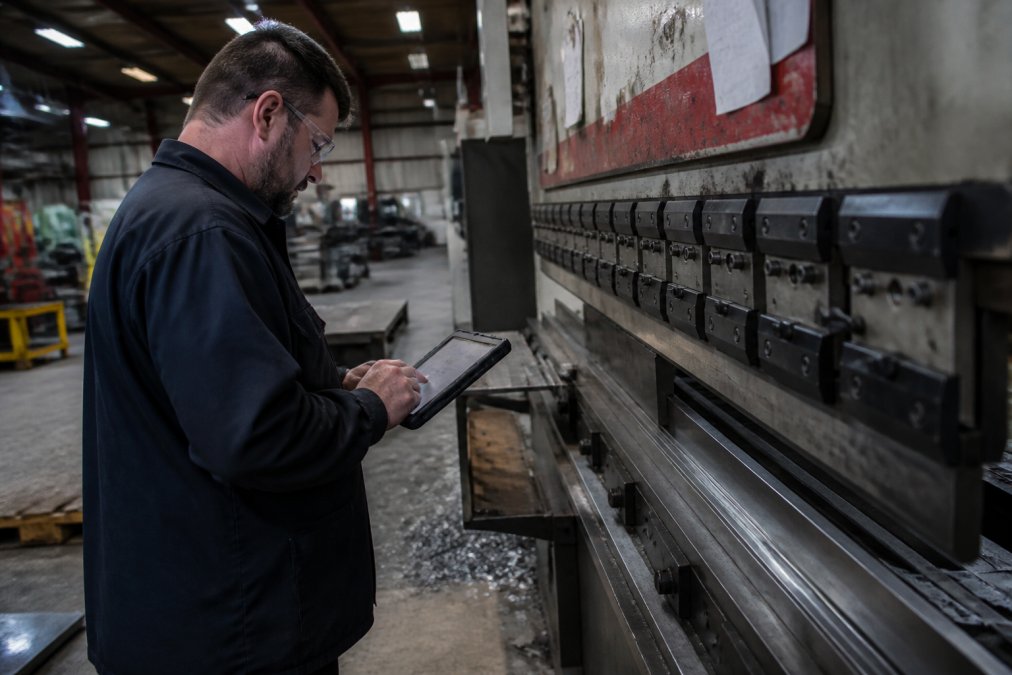
The practical setup for most fabricators looks like this:
- Pull cycle times and run status from the press brake, laser, or welder via the machine’s existing controls where possible
- Capture operator-level events (start, stop, downtime reason) at a terminal or tablet
- Push that data into the ERP so job status updates without anyone typing it twice
The payoff is real-time monitoring that replaces the morning status meeting. A common mistake is buying a dashboard before fixing the data source. If the underlying job data is wrong, the dashboard just makes bad numbers load faster.
Reducing Manual Labor in Fabrication Without Losing Skilled Hands
Reducing manual labor in fabrication is not about replacing your best people. It is about removing the clerical and material-handling work that keeps them from the work they were hired to do. The machinist who spends 90 minutes a day on paperwork is not a productivity problem, he is a symptom of a broken workflow.
Start by measuring where the non-value-added hours actually go. A common pattern in job shops is that the machine is cutting or forming for only a fraction of the shift, and the rest of the operator’s time goes to hunting for the next job, walking to the tool crib, re-measuring a part that was already checked, or re-keying data that already exists in the ERP. Those hours are the target, not the operator.
Here is what that looks like in practice:
- Machine tending: load/unload automation on high-volume parts frees operators for setup and inspection. On a press brake running a repeating part, a robot or cobot tending the bend cycle lets one operator run two or three machines instead of standing at one.
- Material handling: automated storage and retrieval (ASR) cuts the walking and searching that eats cycle time. Sheet and tube stock that is staged by job, not by size, removes the ‘where is the 11-gauge’ conversation from the shift.
- Data entry: a barcode or RFID scan at each operation replaces the paper traveler. The scan is the transaction, job status, operator, timestamp, and machine all update without anyone typing.
- Job scheduling: software sequences work by due date, machine availability, and setup similarity, so the next job is already staged when the current one finishes.
- In-process inspection: a probe or vision check at the machine catches a drift before a full run of scrap is produced, which removes the rework hours that never show up on a job cost until it is too late.
The thing nobody tells you about this transition is that it changes job descriptions, not headcount. Shops that handle it well retrain operators as cell leads, programmers, and maintenance techs. Shops that handle it badly lose their most experienced people to frustration, usually the ones who could have run the new cell best.
Automation does not shrink your headcount. It changes what your headcount does. If you cannot describe the new job description for the operator whose task you are automating, you are not ready to buy the hardware.
A practical first move: pick the single task that consumes the most skilled-operator time per shift and automate only that. Measure the hours returned. If the operator is not doing higher-value work with those hours within 90 days, the automation was aimed at the wrong task.
Throughput, OEE, and Part Accuracy: The Numbers That Move
| Metric | What It Measures | What Automation Improves | Typical Starting Range |
|---|---|---|---|
| Throughput | Parts completed per shift | Cycle time, machine tending, scheduling | Varies by part; measure before and after |
| OEE | Availability x Performance x Quality | Downtime, changeover, scrap rate | World-class is often cited near 85%; many job shops start far below that |
| Part accuracy | First-pass yield and consistency | Repeatable processes, in-process inspection | Track first-pass yield, not just scrap |
- Availability = run time / planned production time. You need a reason code for every stop, including the two-minute ones. If ‘miscellaneous’ is your most-used downtime reason, your OEE number is fiction.
- Performance = (ideal cycle time x total count) / run time. This requires a known ideal cycle time per part, which means your quoting and process data have to be right.
- Quality = good count / total count. Count first-pass parts, not parts that passed after rework.
Do not buy a dashboard before you fix the data source. If the underlying job data is wrong, the dashboard just makes bad numbers load faster, and you will make capital decisions on them.
A practical starting point: pick one cell, define the three factors, and log them manually for two weeks before you automate the collection. The manual log tells you whether the data you plan to collect is even the data you need.
A Step-by-Step Automation Roadmap for Small and Midsize Fabricators
A practical automation roadmap for a 25-150 person fabricator runs in four phases over roughly 12 to 18 months. Trying to do it all at once is the most common reason these projects stall.
Scope each phase to one clearly defined operational problem with agreed acceptance criteria. A fixed outcome you can verify beats an open-ended “digital transformation” every time.
What Competitors Skip: Maintenance, Cybersecurity, and Energy Metrics
Most guides on shop floor automation stop at the ROI slide. The three things that actually determine whether the investment holds up are the ones they skip.
Conclusion: Start With One Process, Not the Whole Shop
The shops that get the most from automation are not the ones that bought the most equipment. They are the ones that fixed one broken handoff, proved it worked, and used that result to fund the next step. The benefits of shop floor automation for metal fabricators compound, but only if you start small enough to finish.
Frequently Asked Questions
How does shop floor automation improve throughput for metal fabricators?
Automation cuts the non-cutting time that eats into every job. Machine tending, material handling, and job scheduling stop waiting on manual handoffs, so a press brake or welding cell keeps running instead of sitting idle between parts. Real-time monitoring shows exactly where the bottleneck is, whether that is setup, changeover, or a downstream operation. Fabricators typically see the biggest throughput gains in high-mix, low-volume work where setup and part tracking used to consume hours per shift.
Can small and midsize metal fabricators afford shop floor automation?
Yes, if you scope it correctly. A 25 to 150 employee shop does not need a full lights-out factory. Starting with one painful process, such as job status tracking or quality documentation, keeps the investment bounded and the payback measurable. Fixed-outcome projects with clear acceptance criteria let owners prove ROI to a CFO before committing to a larger rollout. The mistake is buying hardware first and figuring out the data layer later.
What are the primary challenges when implementing automation in a job shop?
The three that sink most projects are disconnected systems, tribal knowledge, and change resistance. When quoting, scheduling, and production live in separate tools, automation just moves the manual work around. Critical processes that depend on one employee create a single point of failure. And operators who have run the same machine for fifteen years need to see that automation removes the boring parts, not their job. Address all three before you buy anything.
How does Industry 4.0 integration impact metal fabrication efficiency?
Industry 4.0 in a fabrication shop means machines, ERP, and quality records share data automatically instead of through spreadsheets and clipboards. That connectivity gives you real-time monitoring of cycle time, setup time, and OEE without someone walking the floor with a notepad. The efficiency gain comes from faster decisions: you see a problem while the job is still running, not the next morning. Start with one connected data flow, prove it works, then expand.